
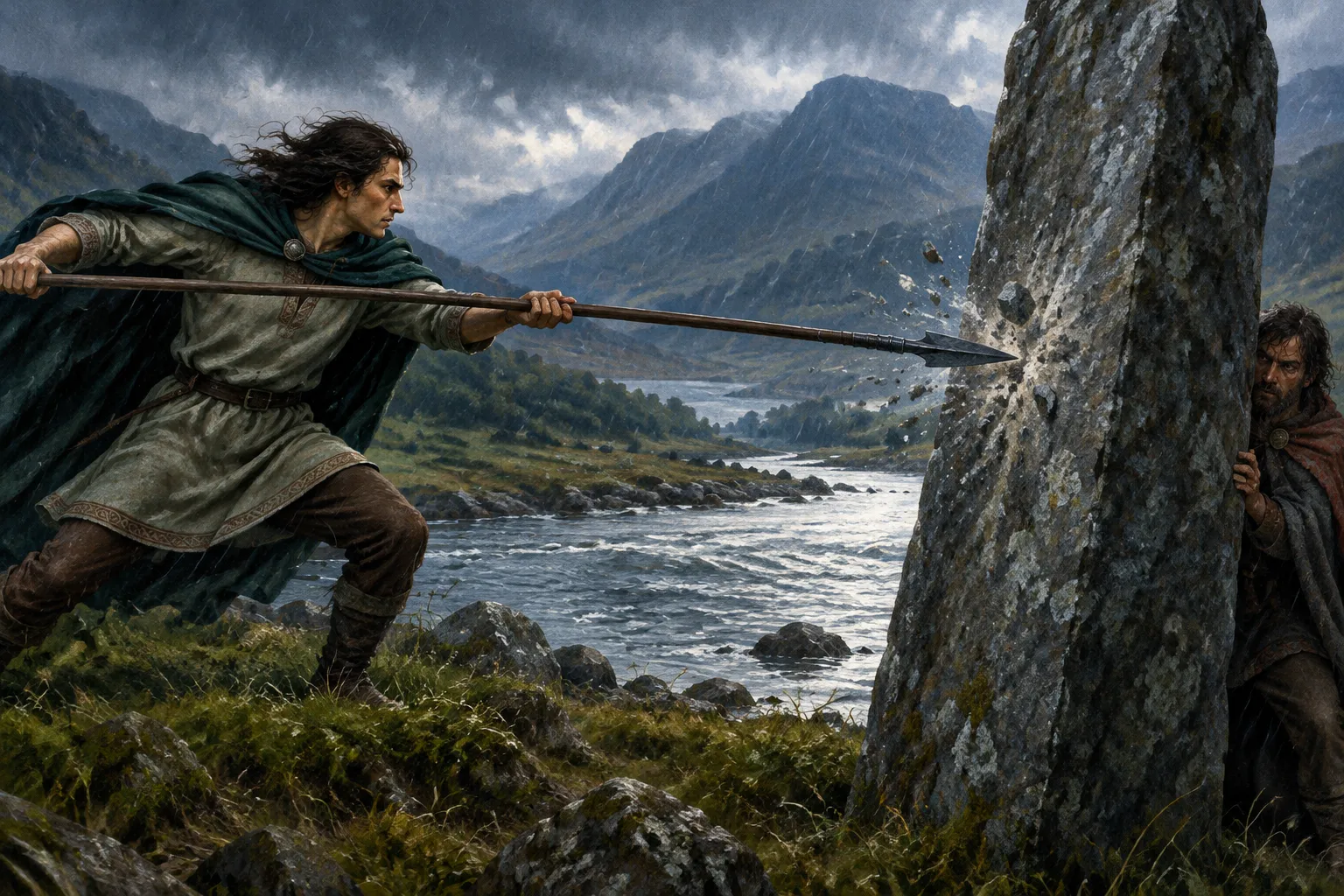
Gronw has one last request before Lleu throws the spear: let him shelter behind the great stone on the riverbank. Lleu agrees. It is an extraordinary concession to the man who ambushed him, took his wife, and seized his land. Yet the stone saves nothing. The spear passes through it and through Gronw, leaving a hole that the storyteller presents as a lasting mark upon the landscape.
This is the closing confrontation of Math fab Mathonwy, the Fourth Branch of the Welsh Mabinogi. Why grant an enemy such protection? Read closely, the episode is more than a demonstration of supernatural strength. It turns an ambush into a public reckoning, reverses the positions of attacker and victim, and makes the recovery of a lordship visible in one impossible throw.
A Welsh story with a medieval written setting
The story belongs to a specifically Welsh literary tradition, not to a single, uniform body of Celtic belief. The National Library of Wales identifies the White Book of Rhydderch, copied in the mid-fourteenth century, as a major witness to the Middle Welsh tales now grouped as the Mabinogion. Its contents include the Four Branches. The library also dates the copying of the Red Book of Hergest, another important witness, to between 1382 and about 1400. These are manuscript dates, not proof that the narratives were first composed then.
The retelling here follows Lady Charlotte Guest’s translation of the Fourth Branch, which spells Lleu’s name “Llew” and the river Cynfael “Cynvael.” Those differences should not be mistaken for separate characters or places. Guest’s English also belongs to a later period: the National Library’s account of her illustrated bilingual edition explains that the translation appeared in seven parts between 1838 and 1849, with assistance from John Jones and Thomas Price.
Keeping these layers distinct matters. We are reading a medieval Welsh narrative through a nineteenth-century English translation, not a transcript of an ancient ceremony. Its dramatic details deserve attention before they are turned into supposed universal symbols.
The protected man who explains his own weakness
Before the betrayal, Lleu has acquired a name, weapons, a wife, and a territory through Gwydion’s interventions. Arianrhod has declared that he will have no wife from the people inhabiting the earth, so Math and Gwydion fashion Blodeuwedd from oak blossom, broom, and meadowsweet. Math then grants Lleu land, and the couple live at Mur y Castell, on the borders of Ardudwy, in Guest’s account of his establishment as a lord.
While Lleu visits Math, Blodeuwedd receives the visiting hunter Gronw Pebyr, lord of Penllyn. They fall in love and plan to remain together. Crucially, Gronw proposes that she discover how Lleu can be killed, disguising her questions as loving concern.
Lleu’s answer sounds reassuring at first. The weapon must take a year to make, with work restricted to the Sunday religious observance described in Guest’s wording. He cannot be killed inside a house or outside one, on horseback or on foot. But he then supplies the exact arrangement that defeats those exclusions: a covered bath beside a river, a goat alongside it, and his own body balanced with one foot on the animal and the other on the cauldron’s edge.
The trap therefore depends on knowledge as much as force. Blodeuwedd does not overpower him; she persuades him to demonstrate a posture he believes they can safely avoid. In the ambush beside the Cynfael, Gronw waits until the conditions are fulfilled and strikes from concealment. Lleu becomes an eagle and escapes with a terrible cry. Gronw subsequently takes Ardudwy, adding it to his existing power in Penllyn.
Recovery must come before revenge
Lleu does not immediately return as an invincible avenger. The intervening rescue makes his suffering difficult to overlook. Searching for his nephew, Gwydion follows a sow whose unexplained daily journeys lead to an oak. Above her sits a decaying eagle; she feeds on the flesh and vermin falling from its body.
Gwydion sings three short verses, bringing the bird lower through the branches until it reaches his knee. Only then does he restore Lleu’s human form with his wand. The result is not a triumphant warrior but an emaciated man. Physicians at Caer Dathyl heal him before the year is over.
That delay changes the force of the ending. The returning spear answers not merely an insult but a prolonged destruction of body, household, and authority. Yet it is worth distinguishing what the text narrates from interpretation: the story explicitly describes his wounds and recovery; reading the final confrontation as a reversal of that helplessness is a way of understanding its arrangement.
Once healed, Lleu asks Math for redress. Math supports his claim to what is rightfully his, and the forces of Gwynedd advance into Ardudwy. Personal revenge and the restoration of territory now move together.
Why Lleu accepts the stone shield
Gronw first attempts a settlement. His messengers ask whether Lleu will accept land, territory, gold, or silver. Lleu refuses. His minimum demand is exact and bodily: Gronw must stand where Lleu stood when he was struck, while Lleu takes the attacker’s former position and casts a spear at him. The terms of the return blow reproduce the geography of the original injury.
Gronw then asks his warriors, household, and foster-brothers whether anyone will receive the blow in his place. None will. The narrator attaches an enduring accusation of disloyalty to their refusal. For a modern reader, however, the scene also exposes Gronw’s isolation: neither wealth nor followers will stand between his own body and the consequence of his act.
At the river he tries one further argument. Blaming a woman’s influence for what he did, he asks permission to put a stone slab between himself and the weapon. That excuse sits uneasily beside the earlier scene in which he himself proposed discovering Lleu’s vulnerability. The narrative gives us grounds to question his attempted transfer of responsibility.
Lleu permits the shield, but the text does not explain his private reasoning. We should not invent a secret rule requiring the concession. As a literary effect, however, the permission makes the victory more emphatic: Gronw receives an advantage he never gave his victim, and it still cannot preserve him.
This differs from the crucial restriction in Pwyll and Arawn’s encounter with the forbidden second blow. Both Welsh tales make the conditions of a strike matter, but here the decisive condition is an agreed reversal of positions, not an instruction to withhold a further attack.
The hole that keeps the story in the landscape
Lleu’s spear passes through the slab and kills Gronw. The narrator then identifies the pierced stone beside the Cynfael in Ardudwy as Llech Gronw. In the closing lines of the Fourth Branch, the landscape retains a material reminder of the encounter, while Lleu recovers his land and is said later to rule Gwynedd.
That is the story’s claim about the stone. It is not archaeological evidence that a historical spear pierced a particular surviving monument. Nor does this passage, by itself, establish that the slab was a place of worship. Its immediate role is narrative: the hole allows the storyteller to point from an extraordinary event toward a named place.
The final throw also differs sharply from the first. Gronw’s attack required secrecy, a year’s preparation, and a carefully staged vulnerability. Lleu’s answer is announced in advance, negotiated through messengers, and delivered to a man allowed to shelter behind stone. The contrast makes restored authority appear in the action itself.
The slab cannot stop the spear because the tale gives Lleu the power to overcome it. But its presence is hardly unnecessary. Without the stone, Gronw simply dies; with it, his failed protection becomes the enduring shape of the ending. The obstacle survives as a witness to the blow that defeated it.
Sources and further reading
- Math fab Mathonwy, translated by Lady Charlotte Guest — the primary narrative followed here.
- National Library of Wales: White Book of Rhydderch — manuscript contents and dating.
- National Library of Wales: A Rare Edition of the Mabinogion — Guest’s translation and its publication history.


