
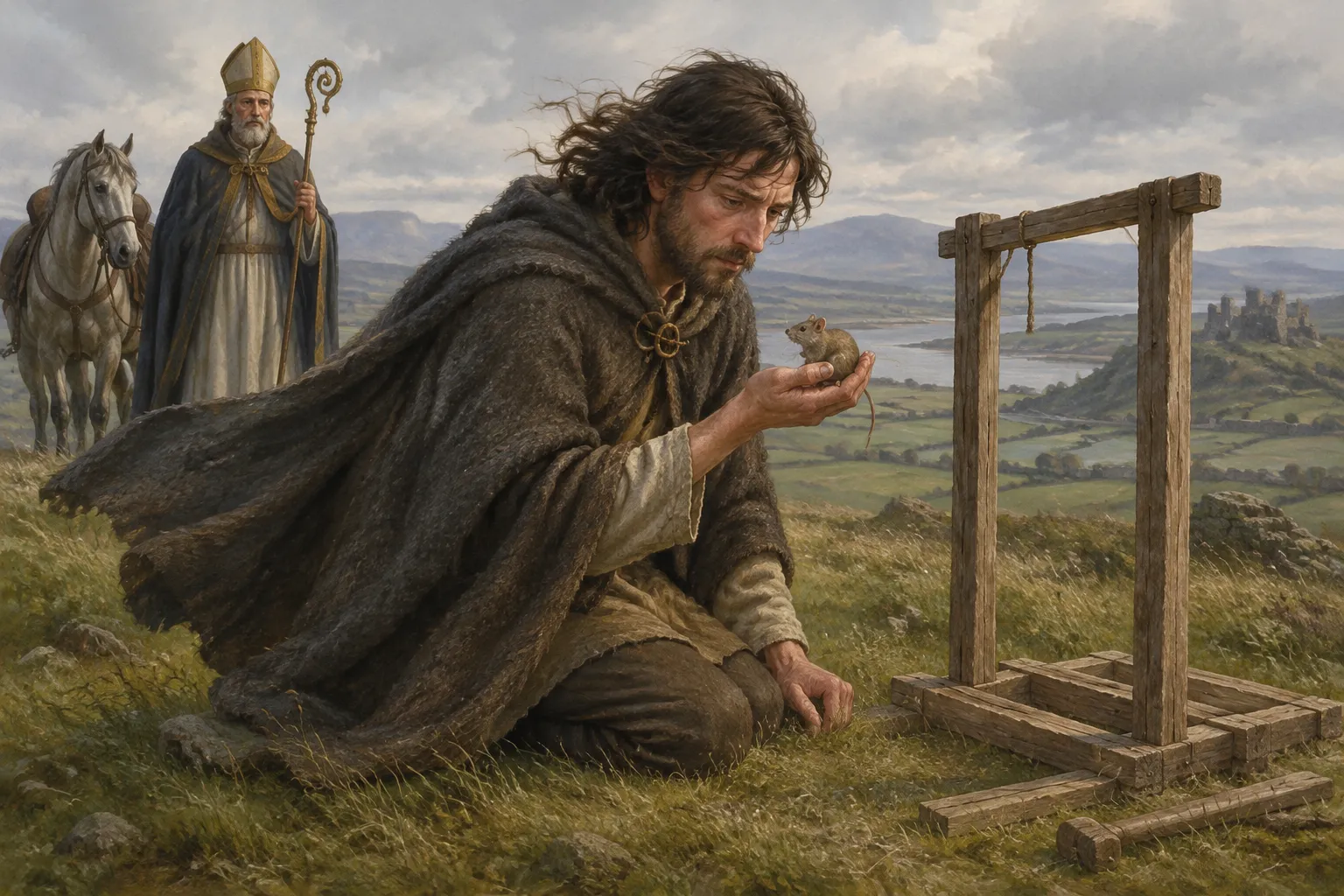
A man stands on a mound preparing to hang a mouse. A scholar asks him to stop. A priest offers money. Finally, a bishop arrives with horses and attendants, ready to pay an extraordinary ransom. The man refuses. He wants something money cannot buy: two missing companions and a country released from enchantment. This is the startling conclusion of the Welsh tale of Manawydan son of Llŷr.
The scene is absurd, but its stakes are not. Read closely, the mouse episode asks how someone can escape a feud whose causes precede his own involvement. Manawydan succeeds not simply by catching an enemy, but by refusing to accept an incomplete peace.
A Welsh story, not a timeless Celtic fable
Manawydan’s story is the Third Branch of the Mabinogi, a connected sequence of medieval Welsh prose tales. Its principal setting is Dyfed, with the court and mound at Arberth—Narberth in Charlotte Guest’s translation—providing the center of the action. Names below use Manawydan and Cigfa where Guest prints Manawyddan and Kicva; these spelling differences should not be mistaken for different characters or separate adventures.
The surviving books matter. The National Library of Wales dates the copying of the White Book of Rhydderch, an important witness to the Mabinogi, to around the middle of the fourteenth century. It also explains that parts of the stories are older than the manuscript. A book’s copying date is therefore not automatically the date when its stories were first composed.
This article follows Guest’s historical English translation for the narrative, checked against the annotated translation at Mabinogi.net. These are two English presentations of the medieval tale, not evidence for two independent ancient myths. The discussion concerns this Welsh literary narrative rather than a belief supposedly shared by every Celtic-speaking community.
Before the mouse: a country without neighbors
At the beginning, Manawydan needs somewhere to belong. Pryderi offers him a home in Dyfed and marriage to his mother, Rhiannon. Rhiannon agrees, and the household formed by Manawydan, Rhiannon, Pryderi, and Pryderi’s wife Cigfa enjoys a period of companionship. Then, while they sit on the mound at Arberth, thunder and mist transform their circumstances. When visibility returns, the inhabited country has disappeared around them; the court stands empty. Guest’s Third Branch describes the vanished people, livestock, and signs of habitation.
The four survive by hunting, then seek a livelihood in England. Their success at making saddles, shields, and shoes brings threats from competing craftsmen. Pryderi repeatedly favors fighting; Manawydan repeatedly chooses departure. He considers consequences beyond the immediate quarrel. In the story’s terms, being capable of violence does not make violence the sensible answer.
Back in Dyfed, a white boar draws the hunters toward a mysterious castle. Pryderi enters against Manawydan’s advice and becomes trapped when he touches a golden bowl. Rhiannon follows and is trapped too. The castle vanishes with both of them. Manawydan and Cigfa are left to support one another, and eventually return to Dyfed with wheat to sow. These events establish the losses that the final bargain must repair, as the narrative leading to the harvest episode makes clear.
Three fields and one slow mouse
Manawydan plants three crofts. The wheat grows beautifully, but the first plot is stripped just before he intends to reap it. The same thing happens to the second. Instead of abandoning the third, he watches through the night. Around midnight, an immense host of mice arrives. Each climbs a stalk, removes an ear of wheat, and carries it away. The damage is precise: the straw remains, while the harvest disappears. Guest’s account of the three crofts makes this theft a carefully staged assault on his livelihood.
He rushes among the mice but catches only one, slower and bulkier than the others. He puts it in his glove and ties the opening shut. At home, he announces that he will hang the thief. Cigfa objects that executing such a creature would disgrace a man of his standing; she does not know any special reason to protect this particular mouse.
The episode unsettles an easy picture of Manawydan as endlessly calm. He is angry and threatens disproportionate punishment. My reading is that the story makes his judgment develop through the encounter: the furious farmer becomes a negotiator. We need not pretend that he captured the mouse with a complete rescue plan already in mind. His exchange with Cigfa supplies anger and determination, not an explanation of hidden strategy.
Why the ransom is never enough
On the mound, Manawydan begins constructing a tiny execution apparatus. Three visitors interrupt him in ascending order of ecclesiastical status: scholar, priest, bishop. Their appeals repeatedly invoke his dignity. Why should a nobleman concern himself with so contemptible a creature? Money is added to persuasion, and the offers rise. Yet the more insistently the mouse is dismissed as worthless, the more remarkable its proposed ransom becomes. The successive visitors and their offers turn a comic spectacle into a contest over concealed value.
The bishop finally invites Manawydan to name his terms. Manawydan asks for Rhiannon and Pryderi, then for the enchantment on Dyfed to be lifted. He also demands an explanation. The mouse is the visitor’s wife, transformed while pregnant; her condition explains why she could not escape with the others. The supposed bishop identifies himself as Llwyd son of Cil Coed, responsible for the enchantment.
Most importantly, Manawydan does not release his captive as soon as restoration is promised. He secures protection against renewed enchantment and against revenge on himself and his companions. The closing negotiation in the annotated translation makes the distinction especially clear: undoing the present injury is not enough if retaliation can simply begin again.
That is the scene’s practical intelligence. Money would compensate the man while leaving the missing people and empty country unchanged. Even recovering the prisoners would be an insecure victory without conditions governing what happens next. Manawydan’s eventual terms address the whole danger rather than its most visible symptom.
The old insult behind the enchantment
Llwyd explains that he acted for his friend Gwawl, humiliated by Pryderi’s father Pwyll in the First Branch. Pwyll’s trick had trapped Gwawl in a bag, where members of the household struck him in the game called badger-in-the-bag. The Third Branch therefore reveals its catastrophe as the delayed consequence of an earlier apparent triumph. Llwyd’s explanation connects the stolen wheat to Gwawl’s humiliation.
Pryderi suffers for his father’s action; Rhiannon, Manawydan, Cigfa, and Dyfed’s inhabitants are drawn into the consequences. This is not an impersonal curse that can be defeated by discovering a magic object. It is deliberate hostility with a history, an agent, and negotiable terms. Readers following Pwyll’s earlier adventures can also explore Pwyll and Arawn’s encounter in the First Branch, another episode in which restraint matters more than an additional blow.
Once the conditions are fulfilled, Manawydan releases the mouse and she becomes a woman again. His achievement is not the destruction of Llwyd’s household. It is the recovery of his own, together with an agreement intended to prevent another cycle of injury. That makes the tiny captive more than an amusing surprise. The mouse forces the enchanter to negotiate—and gives Manawydan the chance to insist that rescue must include a future.
Sources and further reading
- Charlotte Guest’s translation of The Mabinogion, especially “Manawyddan the Son of Llyr”; historical English wording and spellings.
- Manawydan: annotated translation at Mabinogi.net, useful for following the final demands closely.
- National Library of Wales: The White Book of Rhydderch, for the manuscript’s date and storytelling background.


