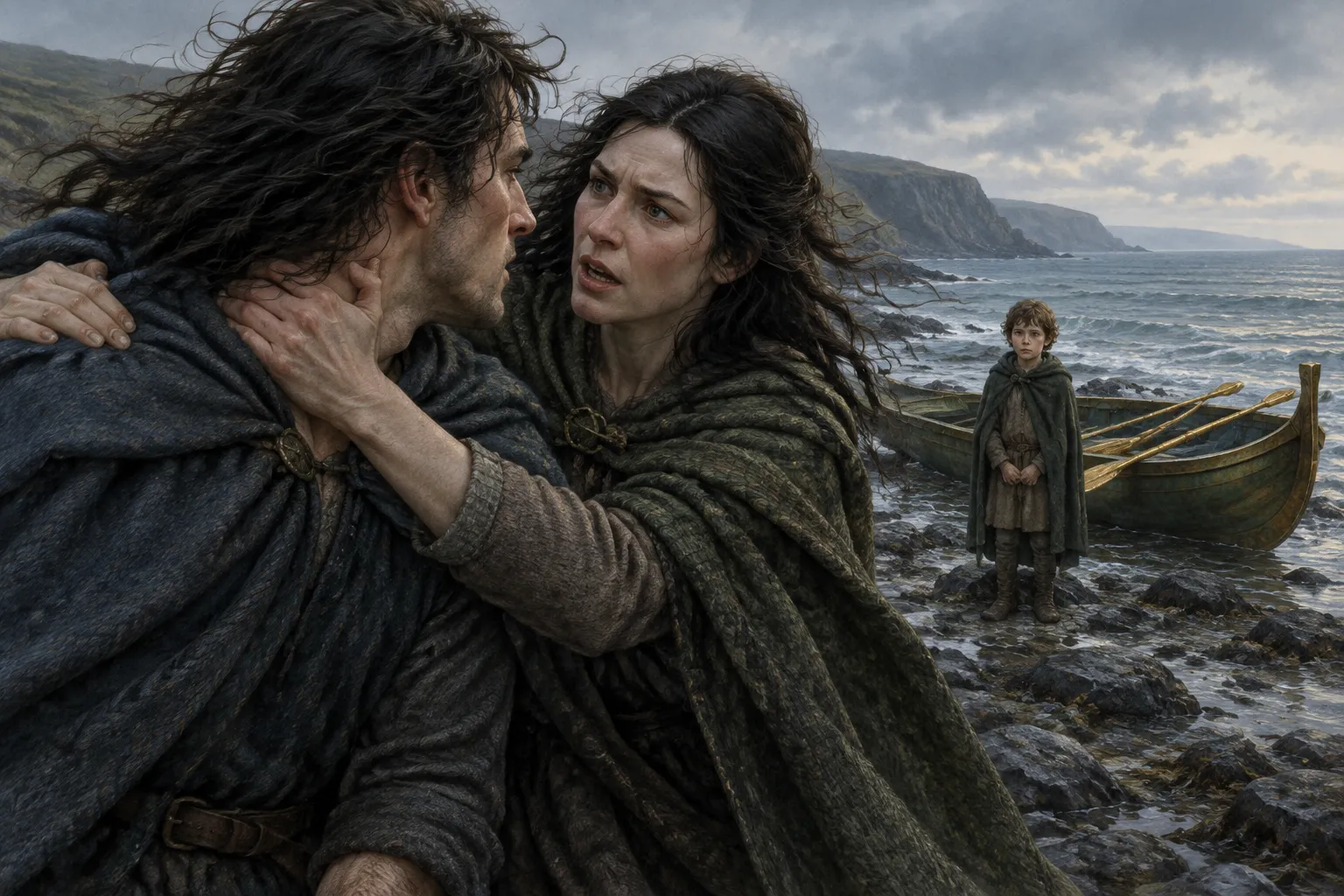
Before Cú Chulainn fights the strange boy on the shore, someone tells him who the child may be. Emer puts her arm around his neck and urges him not to kill his own son. He goes down to fight anyway. That warning makes Aided Óenfir Aífe, usually translated as The Death of Aífe’s Only Son, more disturbing than a simple tragedy of mistaken identity. In the Irish text and translation presented by University College Cork, the possibility of recognition arrives before the fatal encounter.
Why does it fail? The answer lies partly in three commands imposed before Connla’s birth, but also in a father’s refusal to reconsider what honour requires. Read closely, this Irish heroic narrative asks a painful question: what happens when obedience and reputation become more important than the person standing before you?
Three commands that make a meeting impossible
The opening supplies the trap. Cú Chulainn leaves Aífe pregnant after his training with Scáthach. He gives her a golden thumb-ring: when it fits their son, the boy should seek him in Ireland. But he also orders that the child must let nobody divert him, reveal himself to no single man, or refuse single combat. Seven years later, the boy sets out. These are the instructions in the tale’s first two sections.
The ring appears to promise a future reunion. The commands undermine that promise. How can a child find his father while refusing the ordinary questions that might establish their relationship? The contradiction is especially sharp because the father creates both the invitation and the obstacle.
One useful reading is that Connla inherits a heroic identity before he inherits a family relationship. He must be unyielding, anonymous and always ready to fight. Those qualities may look impressive in isolation. Together, they make an ordinary welcome almost impossible. His obedience does not bring him safely home; it prevents him from explaining why he has come.
This is a specific Irish story, not a rulebook for all Celtic traditions. Its commands matter because of how this narrative arranges them, and because the man who issued them will eventually confront their consequences.
A child treated as a threat
Connla approaches the Ulstermen in a bronze skiff with gilded oars, displaying extraordinary skill with birds and sling-stones. Conchobar interprets the performance as a warning: if a child from that country can do so much, its adults might overwhelm Ulster. Condere is sent because of his reason and eloquence, but cannot secure the boy’s identity. Conall then intervenes and is humiliated. The sequence is preserved in the Celtic Literature Collective’s translation.
The telling changes the meaning of the boy’s arrival step by step. What begins as a search for a father becomes a question of territorial danger, then a test of public reputation. Connla has not come to conquer Ulster. Yet the adults increasingly interpret his presence through the possibility of defeat.
Condere’s role makes the escalation more interesting. Speech is attempted before the decisive violence; the story does not imagine a world in which nobody knows another approach exists. But eloquence cannot overcome an instruction that forbids the answer it needs.
On this reading, the tragedy is not caused by strength alone. It grows from an encounter in which each side understands the other through the wrong framework. The boy pursues his journey; the court sees an affront. Neither interpretation produces a safe next step.
Emer supplies the knowledge that pride rejects
Emer’s intervention is the moral hinge. She identifies the boy as Cú Chulainn’s possible son and challenges the wisdom and fairness of fighting him. Cú Chulainn answers that even if the child is his son, he would kill him for Ulster’s honour. Their exchange appears in sections eight and nine of the UCC text.
It would therefore be misleading to describe this version simply as a father unknowingly killing his child. Emer’s warning does not necessarily give him unquestionable proof, but it gives him an urgent reason to stop. The distinction matters: uncertainty could justify inquiry rather than combat.
Emer also offers a different understanding of good judgment. In her argument, refusing the encounter would not mean failing to understand heroism. It would mean recognizing a responsibility that public competition has obscured. Her counsel creates an alternative against which the reader can measure Cú Chulainn’s choice.
Compare, without merging the traditions, the importance of restraint in the Welsh story of Pwyll and Arawn’s forbidden second blow. Here the question is harsher: can a celebrated warrior accept a limit when an audience’s honour seems to demand action? Emer’s warning makes that limit visible.
A victory that exposes its own failure
During the encounter, Connla points out that he could have identified himself if two people had approached together. The fight nevertheless proceeds. He cuts Cú Chulainn’s hair with a controlled sword-stroke and proves formidable in wrestling and water. Cú Chulainn finally uses the gae bulga, a weapon whose use Scáthach had taught him alone. The translation describes this as playing the boy false.
The reference to two questioners opens a particularly uncomfortable possibility. The restriction against naming himself to one man may contain a way out. That does not establish that every difficulty could certainly have been solved, but it prevents the reader from treating the disaster as mechanically unavoidable.
Likewise, the decisive weapon makes victory look less like a vindication than an exposure. Cú Chulainn survives by exploiting knowledge unavailable to his opponent. The encounter can be read as a collapse of the distinction between protecting honour and merely avoiding defeat.
Afterward, he brings Connla before the Ulstermen as his son. The boy takes leave of the assembled heroes and dies; lamentation and burial follow in the closing passage. The community can acknowledge him once it no longer has to make room for him alive. That is perhaps the story’s bitterest reversal.
Why the version matters
The account above follows the compact Irish tale, rather than combining every retelling into one supposedly definitive biography. UCC’s background materials reproduce a later account from Geoffrey Keating’s History of Ireland. Keating places Scáthach in Alba and describes the recognition token as a gold chain, while explicitly recording an alternative ring tradition. His summary also describes Connla’s training and Cú Chulainn’s resort to the ga bolg.
Such differences are not incidental if the question is responsibility. A retelling that omits Emer’s warning directs attention differently from a narrative that lets her speak at length. Likewise, a token intended for recognition may occupy a different place in a compressed account than in a fuller scene. Readers should ask which telling they are encountering before deciding what the father knew.
The UCC background page also sets passages from The Wooing of Emer beside this tale, including the naming of Conla and instructions for his journey. These textual connections locate the episode within Cú Chulainn’s Irish narrative world; they do not turn it into evidence for a uniform ancient Celtic belief.
In the version examined here, the strongest interpretation is not that fate defeats everyone’s best efforts. Connla obeys instructions that endanger him, while Cú Chulainn refuses advice that might save him. The hero wins the encounter and destroys the relationship the journey was meant to create. His failure is not a lack of power, but a failure to recognize when power should yield.


