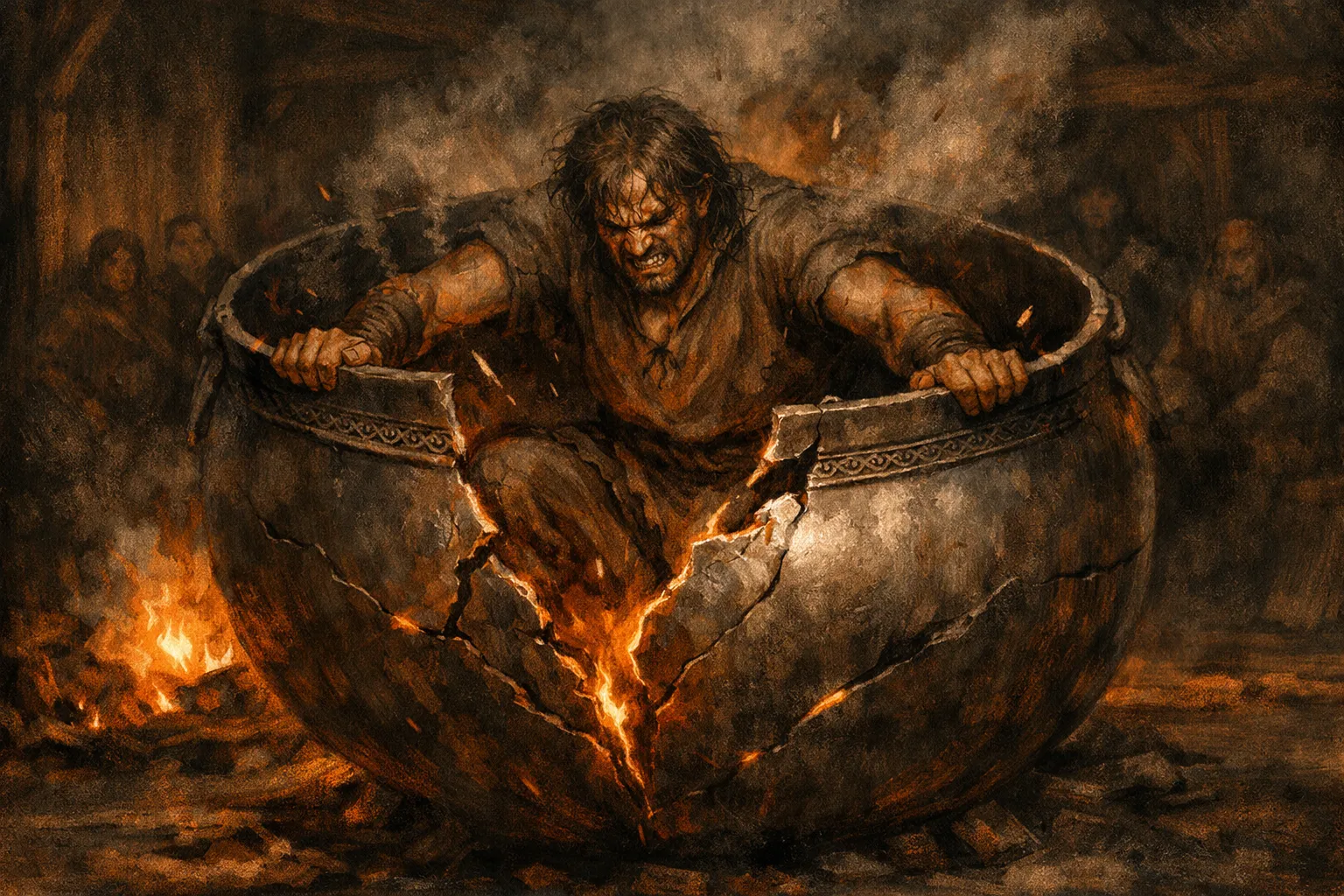
A gift that brings dead soldiers back to life ought to be the answer to a king’s fears. In the Welsh tale of Branwen, it becomes part of a catastrophe. Presented to heal an insult between royal families, the cauldron eventually replenishes the ranks of an army fighting those who gave it away. The decisive act is not winning possession of this treasure, but breaking it.
That reversal makes the cauldron more than a convenient magical object. Read within its own story, it raises an unsettling question: what use is the power to restore bodies when nobody can restore trust?
A Welsh story, not a universal Celtic formula
Branwen, Daughter of Llŷr is the Second Branch of the Welsh Mabinogi. Its manuscript setting matters. The National Library of Wales identifies the White Book of Rhydderch as a major witness to these Middle Welsh tales; it was copied in the mid-fourteenth century. This is medieval Welsh literature, not a surviving handbook of beliefs shared uniformly across the ancient Celtic-speaking world.
The account below follows Lady Charlotte Guest’s translation of the Second Branch, using familiar modern spellings such as Bendigeidfran and Efnysien where Guest’s spellings differ. Her translation gives us a specific narrative to examine, rather than a collection of interchangeable cauldron legends.
Although much of the action takes place in Ireland, the Irish court here is represented within a Welsh tale. Its characters and events should not automatically be treated as independent evidence for Irish religious tradition. Likewise, a vessel that revives warriors does not by itself establish a doctrine of reincarnation. Readers coming from our broader discussion of rebirth in Celtic myth can see why close attention to one text changes the picture.
A peace offering with a military advantage
The trouble begins with a marriage intended to strengthen two kingdoms. Matholwch, king of Ireland, seeks Branwen, sister of Bendigeidfran, king of Britain. As Cadw’s account of Branwen explains, the match is meant to unite the families. But Branwen’s half-brother Efnysien resents not being consulted and brutally mutilates Matholwch’s horses.
Bendigeidfran attempts to settle the injury through compensation. In Guest’s translation, he offers replacement horses, silver and gold. When Matholwch still appears downcast, he adds the cauldron: a slain man placed inside it will be well again the following day, except that he will not recover his speech.
The gift therefore has two functions that sit uneasily together. It expresses generosity, but it also grants a military advantage. Bendigeidfran gives another ruler the means to recover fallen fighters. What looks like an extraordinary guarantee of friendship will become dangerous precisely because friendship cannot be guaranteed.
The scene also distinguishes compensation from reconciliation. Horses and treasure can replace material losses; they cannot compel everyone to relinquish resentment. The cauldron enlarges the payment without resolving that underlying problem.
A history of hospitality turning violent
The vessel already has a troubled history. Asked where he obtained it, Bendigeidfran names Llassar Llaesgyfnewid and his wife, Cymidei Cymeinfoll. Matholwch then recalls encountering the enormous pair in Ireland, the man emerging from a lake with a cauldron on his back. He initially maintained them, but hostility developed after their disruptive conduct. His people eventually attempted to burn them inside an iron house; the couple escaped. Bendigeidfran subsequently received them, and Llassar gave him the vessel, according to the cauldron’s embedded origin story.
This episode need not be reduced to a single hidden meaning. Its narrative effect is clear enough: the peace gift comes with a history of welcome, conflict and attempted destruction. A ruler receives strangers, hospitality fails, and a building becomes a weapon.
Later, another hall will conceal another deadly intention. The repeated movement from reception to violence encourages us to watch the conduct of hosts, not merely the powers of their possessions. The cauldron passes between courts whose relationships are much more fragile than their ceremonies suggest.
Restoring soldiers cannot restore Branwen’s life
Branwen initially receives honour in Ireland and bears a son, Gwern. But resentment over the horses survives. Matholwch sends her to work in the kitchens, where she suffers daily abuse. She eventually trains a starling and sends it to her brother with a message reporting her treatment. Cadw recounts this movement from royal marriage to isolation, which brings the consequences of the failed settlement into focus.
Bendigeidfran comes to Ireland with an army. A further reconciliation is arranged, including a house large enough to accommodate the gigantic king and the transfer of sovereignty to Gwern. Yet armed men are hidden in bags within the building. Efnysien discovers and kills them. Then, during the gathering that follows, he throws Gwern into the fire, and fighting erupts. These events unfold in Guest’s account of the disastrous feast.
The cauldron now fulfils its promise. The Irish place their dead inside it; the following day they emerge as capable fighting men, but unable to speak. The earlier description was not a false advertisement. The horror is that the miracle works.
Its power nevertheless answers only a narrow need. It supplies soldiers. It does not undo Branwen’s abuse, reconcile the families or avert the killing of her child. The distinction is central to this reading: restoring military strength is not the same as repairing a human relationship.
Why destroying the treasure becomes necessary
Efnysien sees the imbalance. The Irish dead are restored, while the men of Britain receive no such renewal. Recognising his part in their predicament, he lies among the Irish corpses. Men collecting the dead mistake him for one of their own and throw him into the vessel. Inside, he stretches himself until he breaks it into four pieces, bursting his own heart in the process, as the translation describes in its account of the cauldron’s destruction.
It is a reversal, but not a simple transformation into an uncomplicated hero. The man who attacked the horses and murdered Gwern now sacrifices himself to remove an advantage from his own side’s enemies. His final act addresses a crisis he helped create; it cannot cancel the earlier acts.
Nor does breaking the cauldron produce a triumphant ending. Only seven men escape from Bendigeidfran’s company, and the king is mortally wounded. Branwen reaches Britain with the survivors, looks towards the two islands and dies of grief. The story explicitly withholds a victorious conclusion. Her self-blame belongs to her anguish; readers need not accept it as a fair assignment of responsibility.
The cauldron’s destruction is necessary within the battle, yet insufficient to repair the world outside it. That is the force of the broken treasure. The tale offers a power strong enough to reverse a soldier’s death, then sets it against injuries that power cannot mend. The vessel can renew an army. Nobody can make the original marriage feast begin again.
Sources and further reading
- Lady Charlotte Guest’s translation of The Mabinogion, especially “Branwen the Daughter of Llyr.”
- Cadw: Branwen Ferch Llŷr, an accessible account of the marriage, insult and Branwen’s mistreatment.
- National Library of Wales: White Book of Rhydderch, covering the manuscript’s contents and history.