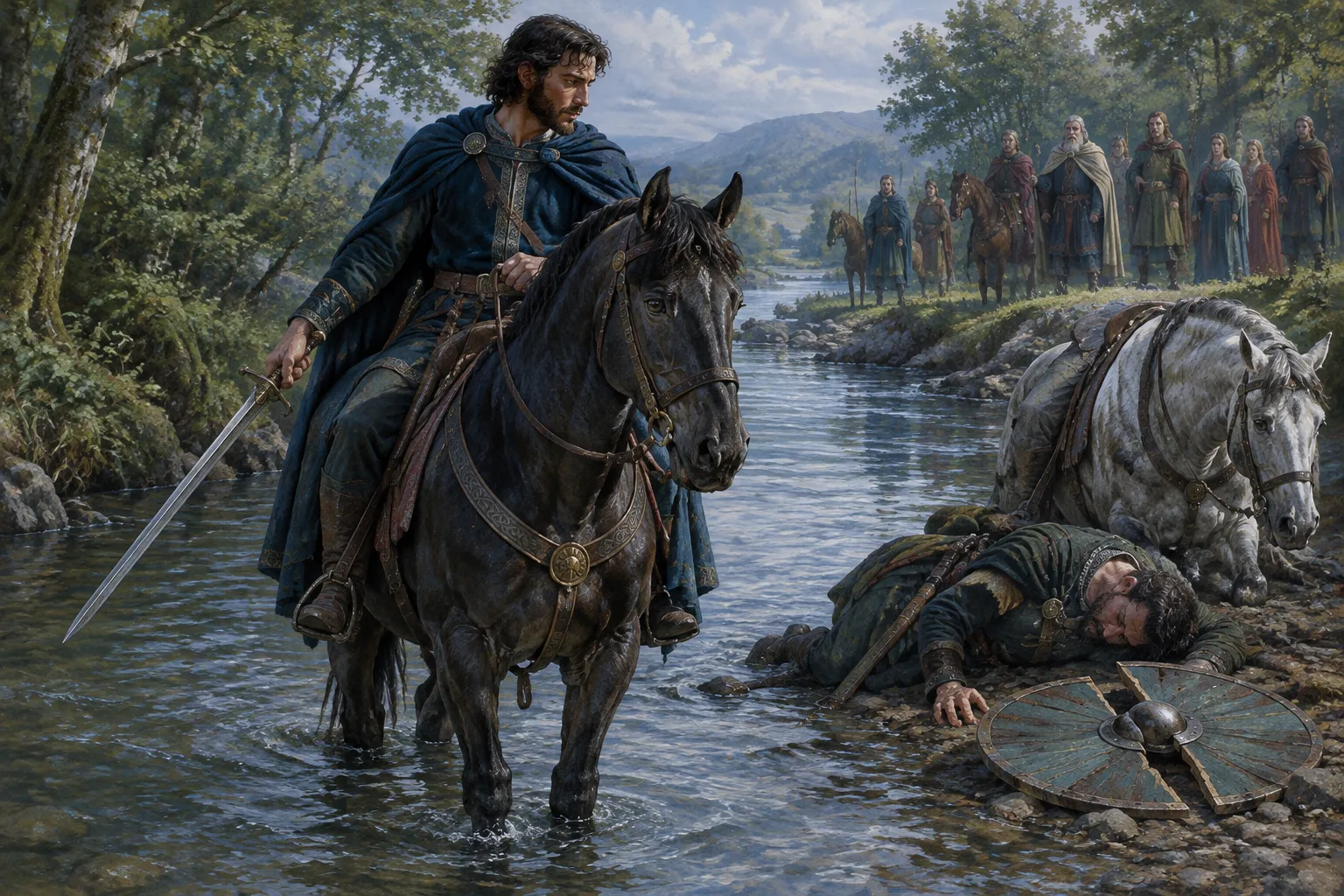
Pwyll has already won. His opponent’s shield has split, his armour has broken, and the wounded king lies on the ground beside the ford. Then comes the dangerous request: finish the fight. For most warriors, another stroke might seem the obvious ending. For Pwyll, it would undo the very thing he came to accomplish.
The opening adventure of the Welsh First Branch of the Mabinogi turns on this peculiar instruction. Pwyll must fight in another king’s appearance, deliver one decisive blow, and refuse to deliver a second. Following that rule transforms an act of hunting discourtesy into an enduring alliance. The question is not simply whether Pwyll can wield power, but whether he knows when to stop.
A Welsh tale with a particular textual history
This is a story of Pwyll, ruler of Dyfed, and Arawn, a king of Annwfn, the Welsh otherworld. It belongs to medieval Welsh literature, not to a single, uniform body of beliefs shared by all Celtic-speaking peoples. Oxford University Press places the surviving tales chiefly in the White Book of Rhydderch, around 1350, and the Red Book of Hergest, around 1400. Those manuscript dates are evidence for transmission, not dates for the events narrated.
The English versions also need distinguishing. Lady Charlotte Guest’s nineteenth-century translation, reproduced by the Celtic Literature Collective, uses spellings such as Dyved, Annwvyn and Havgan. Modern translations commonly give Dyfed, Annwfn and Hafgan. These spellings do not create separate characters. This article uses the latter forms while drawing its main narrative outline from Guest’s complete First Branch.
The story’s otherworld is strikingly political. Arawn has a household, officers, a wife and a neighbouring enemy. Annwfn initially contains rival kingdoms rather than one uncontested monarchy. Whatever larger meanings readers find in it, this episode presents a realm where territorial claims, hospitality and personal obligations matter.
The stolen stag that begins the bargain
Pwyll’s trouble starts during a hunt in Glyn Cuch. Leaving his court at Arberth, he follows his dogs until he becomes separated from his companions. He hears another pack and sees its hounds bring down a stag in a clearing. Their white bodies and red ears arrest his attention. Yet wonder does not make him behave well: he drives them off and lets his own dogs feed on their kill.
The rider who follows them wears grey hunting clothes and carries a horn. His first response is not a magical attack but a refusal to greet Pwyll. When Pwyll assumes the stranger’s rank explains the slight, the rider corrects him. The problem is Pwyll’s conduct. In the confrontation over the stag, the offence is explicitly a failure of courtesy.
That distinction matters. Pwyll has not knowingly challenged an otherworld king. He has taken advantage of someone else’s successful hunt. His first useful action is to offer redress rather than defend his privilege.
Only then does the stranger identify himself as Arawn. Instead of demanding replacement game, he proposes something much larger. Pwyll can secure his friendship by removing the pressure of Hafgan, a neighbouring ruler who repeatedly fights him. An apparently small breach of manners opens into a dangerous obligation.
Borrowing a king’s face and responsibilities
Arawn offers to give Pwyll his appearance and place in Annwfn for a year. He will meanwhile take Pwyll’s appearance and govern Dyfed. Neither household will recognise the substitution. Before departing, Pwyll asks what will happen to his own kingdom—a practical question inside an extraordinary bargain. Arawn’s answer makes the exchange reciprocal rather than a simple disappearance into enchantment.
At Arawn’s court, Pwyll encounters beautifully furnished buildings, attendants who remove his hunting clothes, splendid dress, abundant food and an impressive household. These are the concrete features of Annwfn’s royal hospitality. The episode does not describe a place of punishment. Its marvel lies partly in the heightened excellence of things a courtly audience could recognise.
But appearance gives Pwyll access to more than feasts. In Will Parker’s translation of the bedroom episode, he shares the queen’s bed but turns away from her every night. During the day he remains affectionate in conversation. When Arawn returns, his wife’s surprise reveals Pwyll’s restraint; Arawn understands it as evidence of an exceptionally faithful friend. This material is absent from the Guest text reproduced by the Celtic Literature Collective, an important difference between the accessible English versions.
Read alongside the coming duel, the bedroom episode suggests a pattern: possessing another man’s identity does not make every available action permissible. That is an interpretation of the narrative’s structure, rather than a moral statement directly announced by its storyteller.
Why Hafgan must receive only one blow
Arawn’s instructions are precise. He and Hafgan have an appointment to fight at a ford. Pwyll must attend in Arawn’s likeness and strike once. If Hafgan asks for another stroke, Pwyll must refuse. Arawn explains that when he previously struck again, his opponent was able to fight the following day as effectively as before. The warning against the second blow supplies a rule, but not a detailed explanation of its magic.
We should preserve that limit. The passage does not say that Hafgan possesses a particular talisman, nor does it identify a seasonal ritual behind his recovery. It tells Pwyll what happens and what he must avoid. Turning that instruction into an elaborate lost religious doctrine would go beyond the evidence.
When the appointed meeting arrives, a spokesman orders the assembled nobles to stand aside. The dispute concerns the two rulers and their territories; they alone must fight. Pwyll’s first attack strikes the boss of Hafgan’s shield, breaks through his defences and throws him over his horse’s hindquarters. The physical achievement is spectacular, but it is not yet the whole test.
The fallen Hafgan asks Pwyll to complete his death. Pwyll refuses to strike again and tells him to find someone else. Hafgan then instructs his followers to carry him away, acknowledging that he can no longer support them. Pwyll has obeyed the crucial restriction.
The victory immediately becomes political. He receives allegiance, and by noon the following day both kingdoms are under his authority. His restraint should not be mistaken for a rejection of force altogether: the same passage threatens compulsion against those who will not submit. The narrower achievement is that he uses violence according to the terms of his undertaking, rather than continuing because his opponent invites him to.
What Pwyll brings home from Annwfn
The exchange ends where it began, at Glyn Cuch. Arawn and Pwyll recover their own appearances and return to their households. Back in Dyfed, Pwyll asks his nobles how his government has compared with earlier years. Their answer is awkwardly flattering: he has never been wiser, kinder, more generous or more just. They have, unknowingly, been praising Arawn.
Pwyll does not claim the credit. He explains the substitution, and when his people ask him to preserve the good government they have enjoyed, he agrees. The return to Dyfed and exchange of gifts complete the adventure with accountability as well as reward. The kings maintain their friendship through presents including horses, hounds and hawks. Pwyll acquires the title Chief of Annwfn.
Readers interested in another tightly bounded Welsh narrative can turn to Branwen’s cauldron of rebirth in the Second Branch. Here, however, the decisive marvel is not an object. It is an exchange of appearances that exposes the difference between occupying a position and deserving trust.
Pwyll begins by taking a benefit that is not his. He succeeds by learning to respect limits: the claim on the stag, the responsibilities of a borrowed identity, the instruction governing the duel, and the obligation to acknowledge better rule. His strongest stroke wins the fight. His refusal to strike again makes the victory last.
Sources and further reading
- Oxford University Press: The first branch of the Mabinogi — manuscript context and an excerpt from Sioned Davies’s translation.
- Lady Charlotte Guest: Pwyll Pendeuc Dyfed — the complete First Branch, reproduced by the Celtic Literature Collective.
- Will Parker: The Mabinogi of Pwyll — an annotated translation, including the bedroom and reunion passages.


